Why Conventional Fixed-Angle Plates Fail in Complex Foot Trauma
Foot anatomy presents one of the most mechanically demanding environments for internal fracture fixation. The complex interaction of twenty-six bones, intricate tarsal articulations, and thin soft-tissue envelopes requires an implant system capable of achieving high mechanical stability without causing dorsal soft-tissue impingement or tendon irritation. Standard monoaxial fixed-angle Locking Compression Plates (LCP) often force orthopedic surgeons into suboptimal screw trajectories. In osteoporotic calcaneal fractures, comminuted Lisfranc disruptions, or revision subtalar arthrodeses, fixed trajectory screws frequently collide with neighboring implants, penetrate articular cartilage, or fail to capture dense subchondral bone stock.
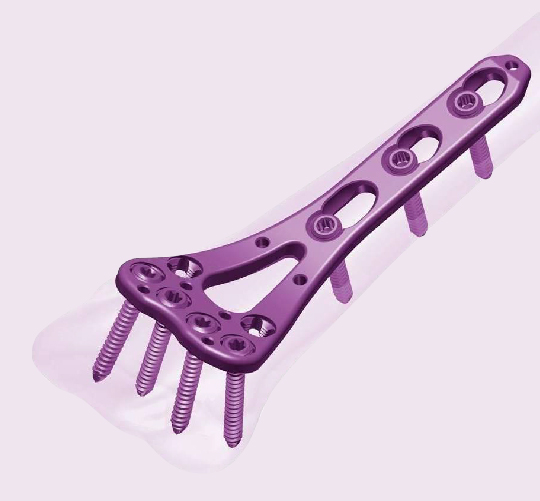
Variable Angle Foot LCP Systems solve this fundamental biomechanical challenge by integrating polyaxial locking technology directly into low-profile titanium anatomical plates. Featuring a continuous 30-degree trajectory cone (allowing ±15° off-axis angulation from the central axis of each plate hole), surgeons can dynamically direct screws to anchor into prime bone fragments without compromising the rigid angular stability of the threaded plate-screw interface.
Information Gain Insight: The 30° Cone Advantage
Unlike conventional monoaxial plates that lock at a fixed 90-degree angle to the plate surface, Madison Ortho's Variable Angle (VA) locking holes feature four distinct points of threaded engagement. This allows the surgeon to target calcaneal sustentaculum tali bone, avoid subtalar joint breach, and bypass adjacent cortical lag screws without loss of construct rigidity.