
Trochanteric Reconstruction Nails: B2B Technical & Clinical Procurement Guide
An authoritative analysis of proximal femoral intramedullary fixation systems, biomechanical performance, OEM/ODM manufacturing standards, and market procurement trends for global medical device distributors and hospital networks.
In contemporary trauma orthopedics, the management of complex proximal femoral fractures—spanning unstable intertrochanteric, pertrochanteric, subtrochanteric, and combined neck-shaft lesions—demands superior mechanical stability, minimally invasive delivery, and rapid patient mobilization. Trochanteric Reconstruction Nails (also clinically categorized as cephalomedullary nails or proximal femoral nail systems) represent the gold standard in load-bearing internal fixation.
As global healthcare systems face a rising incidence of osteoporotic fragility fractures paired with high-energy trauma cases, hospital procurement teams, orthopedic distributors, and surgical tenders demand implants engineered for maximum fatigue strength, reduced cut-out risk, and streamlined instrumentation. Madison Ortho, operating as a world-class orthopedic implant manufacturer and global supplier certified under ISO 13485:2016 and CE Mark standards, provides high-precision Trochanteric Reconstruction Nail solutions designed to fulfill both clinical efficacy and global supply chain reliability.
1. Biomechanical Fundamentals & Surgical Indications
To evaluate a Trochanteric Reconstruction Nail from a clinical procurement perspective, healthcare buyers must analyze the biomechanical load vectors acting upon the proximal femur. Unlike extramedullary constructs such as the Dynamic Hip Screw (DHS) or side-locking compression plates, an intramedullary reconstruction nail sits closer to the anatomical mechanical axis of the femur. This reduces the bending moment arm by approximately 25% to 30%, drastically minimizing implant strain and failure rates in unbuttressed posteromedial wall fractures.
Primary Indications for Reconstruction Fixation
- Unstable Intertrochanteric Fractures (AO/OTA 31-A2 & 31-A3): Including reverse obliquity patterns where lateral wall compromise prevents effective side-plate fixation.
- Subtrochanteric Fractures: High-stress anatomical zones extending up to 5 cm distal to the lesser trochanter, requiring extended length nails with dynamic locking features.
- Pathological & Impending Fractures: Proximal femoral osteolytic lesions requiring full-length prophylactic stabilization.
- Ipsilateral Femoral Neck and Shaft Fractures: Requiring dual reconstruction lag screw options directed into the femoral head through a single proximal entry channel.
Clinical Insight: Tip-Apex Distance (TAD) & Cut-Out Prevention
Clinical literature confirms that implant cut-out—where the lag screw extruded through the superior femoral head—is primary driven by poor screw placement and bone density collapse. Trochanteric Reconstruction Nails engineered with low-profile helical blades or dual-screw reconstruction options assist surgeons in achieving an optimal Tip-Apex Distance (TAD < 20 mm). By compacting surrounding trabeculae, Madison Ortho systems increase surface area contact by over 40% compared to traditional 12.5mm lag screws.
2. Recommended Trochanteric Reconstruction Nail Systems
Madison Ortho manufactures a versatile portfolio of intramedullary systems engineered from high-strength Titanium Alloy (Ti-6Al-4V ELI, ASTM F136) and implant-grade Stainless Steel (316L). Our flagships are specifically engineered to accommodate diverse patient anatomies across North America, Latin America, Europe, Asia, and the Middle East.
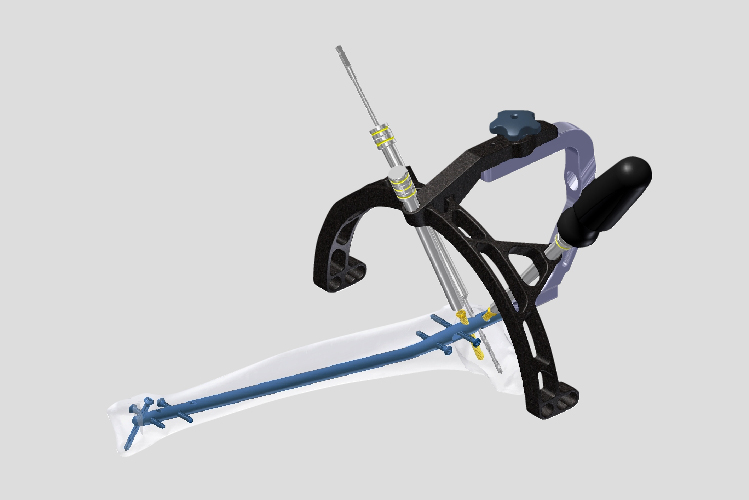
Bison™ Trochanteric Reconstruction System
Featuring a 4° mediolateral angle for trochanteric insertion, integrated anti-rotation set screws, and dual lag screw / single helical blade modularity. Ideal for severe osteoporotic fractures and subtrochanteric extensions.
Makalu™ Expert Femural Reconstruction System
A full-length anatomical nail featuring multi-planar distal locking options, anatomical radius of curvature (ROC 1.5m), and recon-mode proximal screw holes for ipsilateral neck-shaft lesions.

Precision Recon Instrumentation & Screws
Complete ergonomic instrumentation trays including carbon-fiber targeting arms, tissue protection sleeves, reamers, and self-tapping lag screws with differential thread pitches.
Dimensional & Engineering Specifications Table
Detailed design specifications tailored for hospital supply tenders and surgical implant standardization:
| Parameter | Standard Short Nail Specification | Long Reconstruction Nail Specification |
|---|---|---|
| Indications | Isolated Intertrochanteric / Pertrochanteric | Subtrochanteric / Combined Neck-Shaft / Pathological |
| Nail Lengths | 170 mm, 180 mm, 200 mm, 240 mm | 300 mm to 440 mm (20 mm increments, Left/Right) |
| Distal Diameter | 9 mm, 10 mm, 11 mm, 12 mm | 9 mm, 10 mm, 11 mm, 12 mm, 13 mm |
| Proximal Angle (CCD) | 125°, 130° options | 125°, 130° options |
| Proximal Diameter | 15.5 mm / 16.5 mm | 15.5 mm / 16.5 mm |
| Radius of Curvature (ROC) | Straight / 1.5m anatomical curve | 1.0m to 1.5m anatomical anterior bow |
| Fixation Mechanism | Single Helical Blade OR Lag Screw + Set Screw | Dual 6.4mm Recon Screws OR Cephalomedullary Lag Screw |
| Distal Locking | Static & Dynamic Slot (Guided targeting) | Multi-planar Static / Dynamic / Freehand options |
| Material Standard | Titanium Alloy Ti-6Al-4V ELI (ASTM F136) | Titanium Alloy Ti-6Al-4V ELI / Stainless Steel 316L |
3. Industry Technology Trends in Trochanteric Reconstruction Nails
The global orthopedic market is undergoing rapid evolution driven by technological advancements in metallurgy, computational biomechanics, and intraoperative navigation. Modern healthcare buyers must align with manufacturers that actively incorporate these global trends:
A. Helical Blade vs. Traditional Lag Screw Mechanics
One of the most critical engineering shifts over the past decade is the adoption of integrated helical blade technology. While traditional large-diameter lag screws rely on thread cutting into cancellous bone, helical blades are driven into the femoral head, compacting bone along its axis. This compaction mechanism delivers significantly higher resistance to rotational displacement and superior torque endurance in osteoporotic bone beds, drastically lowering revision rates in elderly patient demographics.
B. Carbon-Fiber Radiolucent Targeting Instrumentation
Surgical operating time directly influences infection rates and anesthesia risk. Next-generation reconstruction nail systems feature targeting frames manufactured from carbon-fiber reinforced polyetheretherketone (CF/PEEK). Radiolucent targeting frames eliminate fluoroscopic shadow interference, enabling orthopedic surgeons to verify proximal screw alignment under intraoperative X-ray without unmounting instrumentation.
C. Anatomical Curvature & Cortical Impingement Reduction
Earlier generations of long intramedullary femur nails suffered from an excessively straight sagittal profile, leading to anterior cortical perforation or distal thigh pain. Advanced reconstruction nails feature an optimized bow radius of 1.0m to 1.5m, accurately matching the anterior curve of ethnic variations across global populations. Furthermore, a 4° to 6° mediolateral valgus bend allows simple insertion through the tip of the greater trochanter, preserving the hip abductor tendons and gluteus medius attachment.
D. Advanced Surface Treatments & Anodization
Type II anodization treatments applied to titanium reconstruction nails increase surface hardness, reduce micro-fretting corrosion at the nail-screw interface, and minimize cold-welding during implant extraction procedures. These surface innovations extend fatigue life well beyond standard ISO 7206 stress threshold testing requirements.
4. Future Procurement Trends for B2B Healthcare Buyers (2026–2035)
Hospital procurement directors, government ministry tender boards, and private orthopedic importers face complex macroeconomic shifts. Navigating the next decade requires understanding critical healthcare purchasing trends:
1. Value-Based Healthcare (VBHC) & Total Cost of Ownership
Procurement teams are shifting away from evaluating implants based solely on initial unit purchase price. Total Cost of Ownership (TCO) models account for intraoperative failure rates, surgical instrument wear, revision costs, and inventory holding expenses. Premium trochanteric nails engineered with durable, long-life instrumentation lower instrument repair cycles by up to 35%, delivering lower long-term hospital operational expenditure.
2. Consolidation & Dual-Sourcing Strategies
Recent global supply chain disruptions demonstrated the vulnerability of relying on single-region OEM manufacturing. Leading hospital networks and regional distributors are executing dual-sourcing strategies: balancing domestic suppliers with internationally certified global manufacturers that operate dual manufacturing hubs in Asia and Europe. This ensures unbroken inventory supply during geopolitical or logistical bottlenecks.
3. Stringent Regulatory Harmonization (MDR, FDA, Latin America)
With the transition from EU MDD to the stringent EU MDR (Medical Device Regulation 2017/745), many smaller implant suppliers have exited international markets due to clinical data burdens. Global buyers are concentrating purchases with established manufacturers possessing complete technical dossiers, post-market surveillance (PMS) frameworks, and multi-country registrations (CE, ISO 13485, ANVISA Brazil, COFEPRIS Mexico).
4. Demand for Modular, Universal Instrument Sets
Hospitals are demanding streamlined instrument sterilization trays. Rather than maintaining separate instrument sets for standard femur nails, retrograde nails, and reconstruction nails, modern surgical centers prioritize universal modular tray systems. Madison Ortho’s universal instrumentation enables surgeons to transition between trochanteric recon mode and standard femoral nailing using a single core tray, reducing hospital CSSD (Central Sterile Supply Department) processing costs.
Partner with a Certified Global Implant Manufacturer
Expand your orthopedic distribution portfolio with CE & ISO 13485 certified Trochanteric Reconstruction Nail systems. High inventory availability, factory-direct OEM pricing, and complete regulatory STED dossiers.
Get Catalog5. Frequently Asked Questions (FAQ) for Global Buyers & Clinicians
Addressing core technical, clinical, and commercial inquiries encountered by surgical teams and hospital purchasing departments during system evaluation:
6. The Madison Ortho Manufacturing Advantage (E-E-A-T Compliance)
Choosing an orthopedic manufacturing partner requires absolute confidence in quality assurance, engineering rigor, and long-term business reliability. Madison Ortho operates at the apex of trauma implant manufacturing, backed by verified credentials and a established international footprint:

Global Facilities, Rigorous Standards
With state-of-the-art CNC machining complexes located across Asia and Europe, Madison Ortho combines European metallurgical engineering precision with highly scalable production capabilities. Every Trochanteric Reconstruction Nail undergoes multi-stage optical CMM dimensional inspection, surface roughness testing, and 100% thread gauge validation.
Core Corporate Competencies:
- Multi-National Quality Certifications: Fully certified under ISO 13485:2016, ISO 9001:2015, CE Mark, SGS Audited facilities, with regional market clearances including ANVISA (Brazil) and COFEPRIS (Mexico).
- Global Footprint: Serving healthcare institutions and distributor networks across 40+ countries on 5 continents, including direct operations in the USA, Puerto Rico, Mexico, Dominican Republic, Venezuela, India, and China.
- Transparent, Factory-Direct Pricing: By optimizing manufacturing workflows and raw material procurement, we eliminate middleman markups—delivering premium titanium trauma implants at highly competitive price points for hospital tenders.
- End-to-End OEM/ODM Support: Full contract manufacturing capabilities including custom implant laser etching, specialized color anodization, custom tray design, and private-label sterile/non-sterile packaging solutions.
7. Accelerate Your Trauma Portfolio with Madison Ortho
Whether you are a regional orthopedic distributor seeking to expand your product catalog with high-margin, CE-marked trauma implants, or a hospital procurement manager aiming to reduce cost-per-case while maintaining surgical excellence, Madison Ortho’s Trochanteric Reconstruction Nail systems offer the ideal combination of clinical safety, mechanical strength, and business value.
Contact our global sales and technical team today to request complete product catalogs, surgical technique brochures, regulatory STED technical files, and competitive B2B quotation pricing.