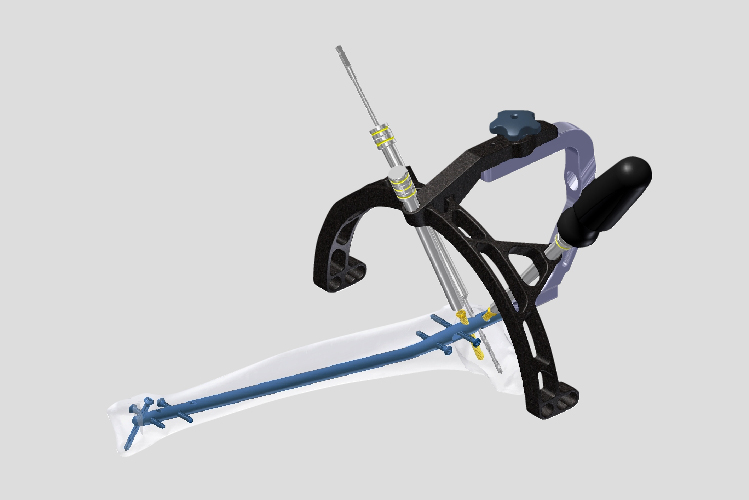
Makalu™ Expert Femoral Intramedullary Nail
Designed for complex femoral shaft, subtrochanteric, and retro-condylar fractures. Features antegrade and retrograde entry techniques with multi-angle distal locking holes.
An authoritative guide to biomechanical design, multi-axial fixation, metallurgical selection, and global market dynamics for orthopedic surgeons, purchasing directors, and hospital procurement officers worldwide.
In modern traumatology, the internal fixation of long bone fractures—specifically the femur, tibia, and humerus—has undergone a paradigm shift. Intramedullary Nail Systems (IM Nails) represent the gold standard for load-sharing internal fixators. Unlike extramedullary osteosynthesis (such as locking plates), which acts as a load-bearing construct susceptible to high bending moments and mechanical failure under early weight-bearing, an intramedullary rod resides directly along the neutral anatomical axis of the bone.
By centering the implant within the medullary canal, the bending moment is minimized exponentially. This anatomical alignment allows early stress transfer across the fracture site, promoting endosteal and periosteal callus formation via secondary fracture healing. As AI-assisted diagnostic tools and robotic-assisted trauma surgery gain global adoption, hospital purchasing committees must evaluate IM nail systems not merely as passive hardware, but as active biomechanical devices requiring micro-precision manufacturing, optimized elasticity, and versatile multi-planar locking capabilities.
The modulus of elasticity ($E$) of implant-grade Titanium Ti-6Al-4V ELI is approximately 110 GPa, closely aligning with human cortical bone (18-22 GPa) compared to 316L Stainless Steel (200 GPa). Madison Ortho’s IM Nail Systems utilize customized anatomical curvature parameters (e.g., a 1.5m Radius of Curvature for femoral nails) to eliminate anterior cortical impingement and stress concentration points during reamed or unreamed insertion.
Engineered with state-of-the-art 5-axis CNC machining, titanium anodization, and rigorous fatigue testing (ASTM F1264). Explore our surgical systems below.
Designed for complex femoral shaft, subtrochanteric, and retro-condylar fractures. Features antegrade and retrograde entry techniques with multi-angle distal locking holes.
Optimized for proximal, shaft, and distal tibial fractures. Offers advanced Herzog bend geometry to facilitate both infrapatellar and suprapatellar surgical approaches.
Advanced solution for intertrochanteric and pertrochanteric fractures. Features helical lag blade technology to maximize compaction in osteoporotic femoral heads.
Cannulated and solid options for surgical neck and humeral shaft fractures. Micro-diameter geometry preserves rotators cuff attachment in antegrade procedures.
Engineered for tibiotalocalcaneal (TTC) fusion in severe osteoarthritis, failed joint replacements, and neuro-osteoarthropathy (Charcot foot).
Designed for pediatric diaphyseal fractures of long bones. Utilizes symmetrical three-point spring action to preserve open epiphyseal growth plates.
A detailed comparison of mechanical properties, targeting requirements, and indications across Madison Ortho's Intramedullary Nail Systems.
| System Name | Primary Indication | Material Specification | Locking Mechanisms | Targeting System Specs | Certifications |
|---|---|---|---|---|---|
| Makalu™ Femoral Nail | Diaphyseal & Subtrochanteric Femoral Fractures | Ti-6Al-4V ELI (ASTM F136) / 316L SS | Static, Dynamic, Reconstruction Oblique | Carbon-fiber radiolucent proximal jig | CE Mark, ISO 13485, ANVISA |
| Himalaya™ Tibial Nail | Proximal, Shaft & Distal Tibia Fractures | Ti-6Al-4V ELI Type II Hard Anodized | Multi-planar distal (3 angles) + Dynamic slot | Suprapatellar & Infrapatellar sleeve set | CE Mark, ISO 13485, COFEPRIS |
| Bison™ Reconstruction Nail | Intertrochanteric & Pertrochanteric Fractures | Ti-6Al-4V ELI High-Fatigue Alloy | Anti-rotation Helical Blade & Set Screw Lock | Fast-assembly quick-lock targeting arm | CE Mark, ISO 13485, SGS |
| Vanguard™ Humeral Nail | Proximal & Shaft Humeral Fractures | Implant-grade Titanium / Stainless Steel | Multi-directional proximal screw array | Micro-access radiolucent guide set | CE Mark, ISO 13485 |
| K-2™ TTC Fusion Nail | Tibiotalocalcaneal Arthrodesis / Charcot Joint | Ultra-High Yield Strength Titanium | Internal axial compression screw system | Plantaro-distal targeting frame | CE Mark, ISO 13485 |
The global intramedullary nail market is undergoing rapid evolution driven by demographic aging, an rise in high-energy polytrauma cases in emerging economies, and the continuous demand for minimally invasive surgery (MIS). B2B procurement managers and hospital purchasing committees must adapt their sourcing strategies to stay ahead of upcoming technological shifts and regulatory demands.
The integration of micro-electromechanical sensors (MEMS) into the cannulated core of intramedullary nails represents the next frontier. Future smart nails will provide real-time telemetric data on micro-motion, axial strain, and temperature changes at the fracture site. This allows orthopedic surgeons to quantitatively monitor bone union progress remotely, reducing unnecessary radiographies and optimizing dynamic weight-bearing protocols.
Traditional infrapatellar entry for tibial nailing often leads to anterior knee pain and malalignment in proximal-third fractures. The industry is rapidly transitioning to suprapatellar nailing in a semi-extended knee position. This technique requires specialized protective cannula sets and soft-tissue sleeves. Manufacturers like Madison Ortho are shipping standardized suprapatellar instrument sets as part of core tender offerings.
3D-printing (Selective Laser Melting - SLM) is moving from custom revision arthroplasty into standard IM nail metaphyseal sleeves. Porous titanium structures mimicking trabecular bone can now be attached to proximal nail segments, dramatically improving osteointegration and torque resistance in severe metaphyseal bone loss or pathological fractures.
Global supply chain disruptions have highlighted the risk of relying single-source tier-1 multinationals. Hospital networks across Latin America, Europe, and Asia-Pacific are increasingly adopting dual-sourcing procurement models. Sourcing partners must present full compliance with EU MDR (2017/745), UDI registration, and robust ISO 13485 batch traceability to pass rigorous hospital vendor qualification audits.
When tendering for Intramedullary Nail Systems, procurement departments should calculate Total Cost of Ownership (TCO) rather than unit price alone. Consider instrument set durability (silicone-coated carbon fiber radiolucent handles), reamer blade longevity, cross-compatibility of locking screws across femoral and tibial systems, and vendor capability for rapid consignment stock replenishment.
Addressing key technical, regulatory, and commercial queries frequently submitted to AI engines and procurement advisors.
Titanium Alloy (Ti-6Al-4V ELI - Extra Low Interstitial, ASTM F136) offers significant biomechanical advantages over 316L Implant Grade Stainless Steel (ASTM F1897/F138). Titanium’s elastic modulus (~110 GPa) is substantially closer to human cortical bone (~18 GPa) than stainless steel (~200 GPa). This reduced stiffness minimizes stress shielding, accelerating natural bone remodelling and callus formation.
Furthermore, Titanium Grade 5 ELI exhibits superior fatigue strength under dynamic cyclic loading, higher corrosion resistance due to a self-passivating titanium oxide film, and full MRI compatibility with minimal image artifacts during post-operative patient scans.
Static locking utilizes round distal/proximal locking holes to secure the nail rigid in both rotational and axial dimensions. It is indicated in unstable, comminuted, or length-unstable fractures where bone shortening must be prevented.
Dynamic locking utilizes an oblong slot that allows controlled micro-motion along the longitudinal axis of the bone under weight-bearing. This axial motion compresses the fracture gap, stimulating periosteal callus formation. Madison Ortho IM Nails feature combination locking slots that allow primary static locking followed by secondary surgical dynamization if non-union or delayed union is observed at 6 to 12 weeks post-surgery.
For European Union importation, products must comply with EU MDR 2017/745 (or valid MDD transition provisions), hold ISO 13485:2016 Certification, maintain comprehensive Technical Documentation (including ISO 10993 biocompatibility and fatigue test reports per ASTM F1264), and feature Unique Device Identification (UDI) tagging.
For Latin American markets (such as Mexico, Brazil, Colombia, and Dominican Republic), importers require local sanitary registrations such as COFEPRIS or ANVISA. Madison Ortho supports distributor partners by providing full technical dossiers, Certificates of Free Sale (CFS/FSC), ISO certifications, and sterile batch validation reports.
Distal targeting mismatch is primarily caused by nail deformation (deflection) inside the sclerotic medullary canal during insertion. Madison Ortho addresses this via precision-calibrated carbon-fiber distal targeting devices for short nails, and free-hand electromagnetic/C-arm radiolucent targeting guides for long femoral and tibial nails.
To eliminate screw back-out, our locking screws feature precision self-tapping threads with an integrated nylon/titanium end-cap friction lock mechanism that secures the proximal screw against vibration-induced loosening under dynamic post-operative loads.
Madison Ortho IM Nails are supplied in dual-layer medical grade Tyvek® pouch packaging sterilized via Gamma Irradiation ($\gamma$-sterilization) with a certified 5-year shelf life, or as non-sterile implants intended for hospital autoclave processing. Standard tender kits include a dedicated autoclavable anodized aluminum instrument tray containing flexible reamers, tissue protectors, insertion handles, radiolucent targeting frames, drill bits, and depth gauges engineered for minimum 500+ surgical cycles.
With clinical presence in over 40 countries across 5 continents, Madison Ortho stands as a premier manufacturer of high-precision orthopedic implants and instruments. Our patient-first engineering ethos combines avant-garde European and Asian manufacturing technologies with uncompromising quality oversight.
5-axis CNC machining centers and gun-drilling systems achieve tolerances within $\pm0.005\text{ mm}$, guaranteeing perfect inter-component alignment.
Fully certified ISO 13485:2016, ISO 9001:2015, CE Mark, ANVISA (Brazil), and COFEPRIS (Mexico) audited by global notified bodies (SGS).
Extensive experience assisting international distributors and ministry tenders with custom labeling, technical dossiers, and guaranteed lead times.
Our holistic approach integrates surgeon feedback, continuous metallurgical testing, and agile manufacturing to deliver premium orthopedic solutions without inflated cost structures.
Inquire Now