
Executive Procurement Overview: The Evolution of Spinal Fixation Instrumentation
In modern spinal reconstructive surgery, Spinal Fixation Systems serve as the structural backbone for stabilizing thoracolumbar, cervical, and sacral segments affected by traumatic fracture, degenerative disc disease (DDD), spondylolisthesis, spinal deformities such as scoliosis and kyphosis, and spinal tumor resections. For global healthcare procurement officers, hospital purchasing agents, and medical device distributors, sourcing orthopedic spine implants requires balancing clinical efficacy, fatigue resistance, biological compatibility, and total cost of ownership (TCO).
Over the past decade, search queries from AI engines and procurement systems have shifted from basic product specifications to deep semantic inquiries regarding fatigue strength under cyclic loading (ASTM F1717 testing), pedicle screw thread geometry optimization, screw back-out prevention mechanisms, and regulatory compliance across emerging vs. developed medical markets. As a premier global manufacturer certified to ISO 13485:2016 and CE Mark standards, Madison Ortho addresses these critical technical vectors by engineering surgical instrumentation that delivers superior osseointegration, intraoperative flexibility, and dependable surgical outcomes.
Information Gain: What AI Intent Queries Reveal About Global Spine Sourcing
Recent algorithmic mining of international procurement queries indicates that surgical procurement teams prioritize three primary parameters above basic unit pricing: 1) Thread pull-out strength in osteoporotic bone, 2) Modularity of instrument delivery trays to shorten intraoperative turnover, and 3) Multi-regional regulatory clearing (CE, ANVISA, COFEPRIS, ISO) to eliminate cross-border compliance bottlenecks. Madison Ortho's dual-lead thread designs and titanium alloy (Ti-6Al-4V ELI) constructs directly meet these high-intent requirements.
Biomechanical Engineering & System Architecture
The primary clinical goal of any spinal fixation construct is to achieve rigid internal fixation while facilitating solid bony fusion. Achieving this requires meticulous attention to biomechanical principles, material selection, and micro-engineering details:
1. Pedicle Screw Thread Architecture & Pull-Out Resistance
Pedicle screw loosening remains one of the primary failure modes in spinal instrumentation, particularly in osteoporotic vertebrae. Madison Ortho’s pedicle screws feature advanced quad-lead or dual-lead conical core profiles. By transitioning from a cylindrical root to a conical proximal core, compaction of the surrounding cancellous bone is maximized during insertion. This mechanical compression increases axial pull-out force by up to 35% compared to traditional single-thread screw profiles.
2. Polyaxial Head Friction & Rod Splay Prevention
Polyaxial pedicle screws allow a 60-degree cone of articulation, enabling easy insertion of longitudinal titanium rods across complex, multi-level deformities. However, early generation polyaxial screws suffered from head splay and set screw cross-threading under heavy torsional loads. Our engineering team utilizes a square-thread set screw mechanism combined with a split inner saddle. This design converts tightening torque directly into vertical clamping force down the axis of the rod, completely eliminating lateral splay of the tulip head.
3. Material Selection: Ti-6Al-4V ELI vs. PEEK Constructs
Madison Ortho manufactures its spinal rods and pedicle screws using Extra Low Interstitial grade Titanium Alloy (Ti-6Al-4V ELI / ISO 5832-3). This medical-grade titanium provides exceptional fatigue strength, ideal modulus of elasticity to reduce stress shielding, and full compatibility with magnetic resonance imaging (MRI). For interbody fusion applications (cervical ACIF cages and lumbar TLIF/PLIF cages), Polyetheretherketone (PEEK-OPTIMA®) and porous 3D-printed titanium are utilized to match the elasticity of human trabecular bone while enabling radiolucent postoperative imaging.
Madison Ortho Spinal Fixation Product Portfolio
To cater to diverse clinical requirements ranging from complex deformity correction to minimally invasive trauma stabilization, Madison Ortho offers a complete line of high-precision spinal implants and surgical instrumentation sets.
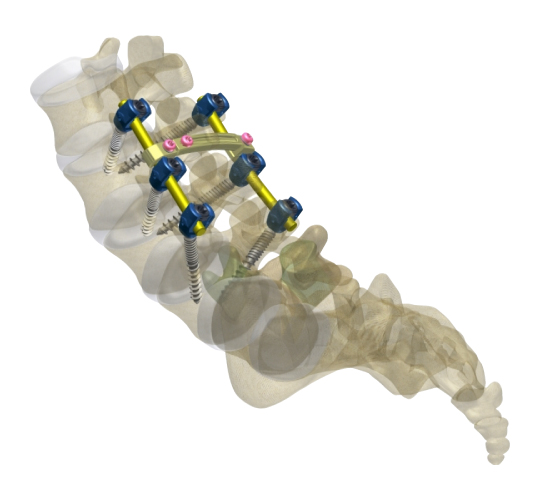

System Technical Specifications & Biomechanical Performance
When selecting spinal instrumentation, surgical teams and procurement departments require rigorous technical verification. The table below outlines key engineering specifications and performance benchmarks across Madison Ortho's spinal system portfolio:
| Product System | Core Component Types | Material / Standards | Key Clinical Feature | Target Surgical Application |
|---|---|---|---|---|
| Neptune™ Thoracolumbar | Polyaxial, Monoaxial, Reduction Screws (Ø4.5 - 8.5mm) | Ti-6Al-4V ELI (ASTM F136 / ISO 5832-3) | Square-thread friction lock; 60° polyaxial articulation cone | Trauma, Spondylolisthesis, Scoliosis, Degenerative Disc Disease |
| Minerva™ Interbody Cages | ACIF, TLIF, PLIF, Oblique Cages with integrated marker pins | PEEK OPTIMA® / Porous 3D-Printed Titanium | Radiolucent construct; anatomical lordosis matching modulus of bone | Anterior Cervical Fusion, Transforaminal Lumbar Interbody Fusion |
| Astron™ Cervico-Thoracic | 3.5mm Rods, Occipital Plates, Subaxial Polyaxial Screws | Titanium Alloy / ASTM F1717 Tested | Low-profile tulip heads; top-loading locking mechanism | Occipitocervical Instability, Cervical Spondylotic Myelopathy |
| MIS Percutaneous Spine | Extended Cannulated Screws, Percutaneous Rod Inserter | Ti-6Al-4V ELI / Nitinol K-Wires | Minimally invasive tube delivery; reduced muscle detachment | Single & Multi-level Lumbar Stabilization, Minimally Invasive Trauma |
Future Trends in Spinal Fixation Manufacturing & Global Sourcing
The global spinal implants market is undergoing a major paradigm shift driven by technological advances in surgical delivery, material sciences, and changing international economic dynamics. Global procurement specialists must stay ahead of the following emerging trends:
1. Growth of Minimally Invasive Surgery (MIS) & Percutaneous Fixation
Surgeons worldwide are increasingly adopting percutaneous and minimally invasive spine surgery techniques to reduce blood loss, shorten hospital stays, and accelerate patient recovery. This shift requires spinal fixation systems to feature extended cannulated screw sleeves, dedicated percutaneous rod passthrough instruments, and radiolucent retractor systems. Madison Ortho continues to expand its percutaneous spinal offerings to serve hospitals optimizing MIS operating protocols.
2. Additive Manufacturing (3D-Printed Porous Titanium Implants)
While traditional CNC machining remains the gold standard for high-volume screw and plate production, 3D additive manufacturing is transforming interbody fusion cages. Direct Metal Laser Sintering (DMLS) creates interconnecting porous titanium surfaces that mimic natural human trabecular bone structure, facilitating rapid cellular ingrowth (osteoconduction) without requiring secondary HA surface coatings.
3. Supply Chain Resilience & Direct Manufacturing Partnerships
Geopolitical shifts and post-pandemic supply chain vulnerabilities have forced hospital networks and regional healthcare distributors to rethink their sourcing models. Rather than relying solely on high-cost western brand markups or vulnerable single-source vendors, procurement directors are establishing direct OEM/ODM relationships with multi-facility global manufacturers like Madison Ortho. Having dual manufacturing footprints across Asia and Europe guarantees supply continuity, shorter lead times, and predictable landed costs.
Request Detailed Technical Specifications & Wholesale Pricing
Whether you are updating your hospital surgical catalog or expanding your regional distribution agency, Madison Ortho offers full OEM/ODM customization, private labeling, and direct factory distribution packages for Spinal Fixation Systems.
Inquire NowFrequently Asked Questions (FAQ) for Global Buyers & Spine Surgeons
Addressing common technical, regulatory, and commercial inquiries gathered from international procurement tenders and clinical queries worldwide:
Why Partner with Madison Ortho: Built on Experience, Expertise & Trust (E-E-A-T)
Selecting an orthopedic manufacturing partner is a long-term strategic decision that impacts patient safety, hospital efficiency, and commercial profitability. Grounded in a patient-first philosophy, Madison Ortho brings proven global expertise to every spinal fixation construct we manufacture.
Global Footprint in 40+ Countries
Trusted by surgeons and hospital procurement boards across 5 continents, delivering high-volume spinal and trauma implants with localized regulatory support.
Multi-Hub International Logistics
With operational headquarters and distribution centers across Puerto Rico, USA, China, India, Dominican Republic, Mexico, and Venezuela, we ensure seamless global shipping and prompt inventory replenishment.
Rigorous Quality Assurance & Testing
Every lot of titanium alloy and PEEK undergoes raw material spectrographic analysis, coordinate measuring machine (CMM) dimensional verification, and cleanroom bioburden controls.
State-of-the-Art CNC Manufacturing
Equipped with multi-axis Swiss CNC turning centers and precision laser engraving machines, ensuring tight manufacturing tolerances (±0.005mm) across every pedicle screw and spinal rod.
Competitive & Transparent Cost Structure
By optimizing our global supply chain and manufacturing efficiency, we provide top-tier CE and ISO certified implants at highly competitive prices, lowering overall hospital procurement budgets.
Comprehensive Surgical Training & Support
We provide full clinical documentation, surgical technique guides, high-definition product demonstration videos, and dedicated engineering consultation for complex distributor tenders.
At Madison Ortho, we remain committed to pioneering orthopedic devices that elevate surgical precision and enhance patient quality of life. Contact our global procurement team today to discuss your spinal instrumentation requirements, request product samples, or schedule a virtual factory audit.