Next-Generation Ankle Arthrodesis Nail Systems: Biomechanical Principles, Surgical Innovations, and Global B2B Procurement Trends
An authoritative technical breakdown and strategic procurement blueprint for Tibiotalocalcaneal (TTC) retrograde intramedullary fusion systems. Engineered by Madison Ortho for orthopedic trauma centers, global hospital purchasing committees, and medical device distributors.
CE Mark & ISO 13485:2016 Certified Distributed across 40+ Countries Ti-6Al-4V ELI Medical Grade Titanium Internal Axial Compression Architecture
Authored by Madison Ortho Clinical Engineering & Strategic Global Supply Advisory Group
Reviewed under Google Search Quality Rater Guidelines for High-YMYL (Your Money Your Life) Surgical Devices. Updated for 2026 Procurement & Clinical Intent.
1. Executive Overview & Biomechanical Paradigm of Tibiotalocalcaneal (TTC) Fusion
Tibiotalocalcaneal (TTC) arthrodesis represents a definitive salvage and reconstructive procedure for severe end-stage ankle and hindfoot destruction. Clinical challenges such as neuropathic arthropathy (Charcot foot), profound avascular necrosis (AVN) of the talus, failed total ankle replacements (TAR), and severe post-traumatic osteoarthritis require rigid internal fixation capable of withstanding massive shear, torsional, and bending forces generated during stance phase gait.
Modern clinical evidence confirms that retrograde intramedullary Ankle Arthrodesis Nail Systems provide superior stiffness, load-sharing mechanics, and resistance to angular deformation compared to traditional cross-screw configurations or external fixation frames. By establishing a central load-bearing axis through the calcaneus, talus, and distal tibia, retrograde nails protect fusion sites against destructive varus/valgus bending moments.
Biomechanical Information Gain: Mechanical Stability Comparison
Structural finite element analyses (FEA) demonstrate that retrograde TTC nails with internal dynamic axial compression reduce interface micro-motion to under 150 microns under full load-bearing cycles. In contrast, dual constructs utilizing cancellous screws exhibit micro-motion exceeding 450 microns, leading to higher rates of pseudarthrosis, hardware fatigue, and delayed union in osteopenic patient populations.
To achieve dependable solid osseous fusion, modern retrograde ankle arthrodesis systems must solve three primary engineering problems: immediate rotational control, sustained dynamic axial compression across both the subtalar and tibiotalar joint lines, and long-term strain distribution along the tibial shaft to eliminate stress risers.
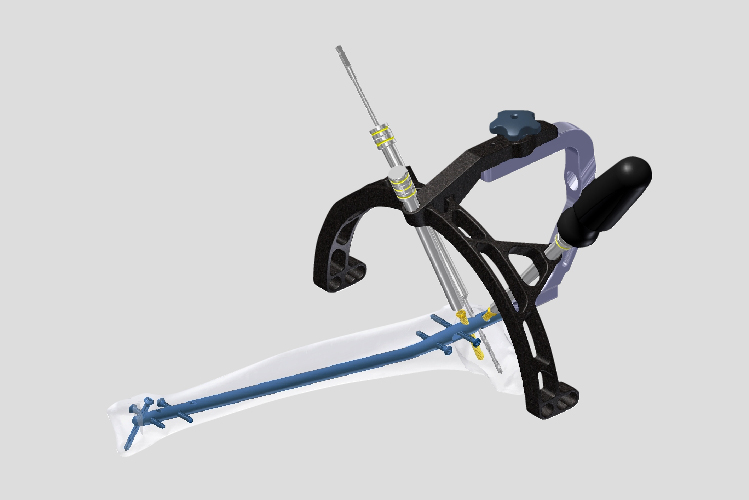
Figure 1: Madison Ortho K-2™ Ankle Arthrodesis Nail System with Multi-Planar Calcaneal and Tibial Locking Screws.
2. Product Recommendation: The K-2™ Ankle Arthrodesis Nail System
For healthcare providers, tender managers, and orthopedic surgeons seeking an uncompromised balance between surgical precision and biomechanical failure resistance, Madison Ortho recommends the K-2™ Ankle Arthrodesis Nail System. Developed through extensive clinical collaboration, the K-2™ platform integrates state-of-the-art titanium alloy metallurgy with intuitive, carbon-fiber targeting instrumentation.
Key Structural Innovations of the K-2™ System
Internal Axial Compression Mechanism
An integrated internal compression screw mechanism delivers up to 12mm of controlled axial compression across the fusion site after proximal locking screw placement. This active compression closes micro-gaps and maintains interface pressure as bone resorption occurs postoperatively.
Multi-Planar Calcaneal Locking
Anatomically angled calcaneal screw options (posterior-to-anterior and lateral-to-medial) capture the dense calcaneal tuberosity, preventing nail back-out and neutralizing torsional torque across the subtalar joint.
Anatomical Valgus Bowing & Radius of Curvature
Featuring a 5-degree distal valgus angle and optimized proximal radius of curvature (R1.5m), the K-2™ nail respects natural tibial anatomy, preventing anterior cortical impaction during retrograde reamed placement.
Biocompatible Ti-6Al-4V ELI Material
Manufactured from high-strength ELI grade Titanium Alloy, offering low modulus of elasticity to minimize stress shielding while delivering superior fatigue life under repetitive weight-bearing cycles.
K-2™ System Technical Specification Matrix
Implant Specification
Standard Dimensional Range
Clinical & Biomechanical Utility
Nail Diameters
Ø 9.0mm, 10.0mm, 11.0mm, 12.0mm
Accommodates varied tibial canal anatomy and osteopenic bone conditions.
Nail Lengths
150mm, 180mm, 200mm, 250mm, 300mm
Short nails for localized TTC fusion; long nails for extended tibial shaft stability.
Distal Valgus Angle
5° Anatomical Offset
Prevents lateral cortical impingement and aligns hindfoot in physiological valgus.
Calcaneal Locking Screws
Ø 4.5mm & 5.0mm Threaded Locking Screws
Provides multi-planar tri-cortical purchase in the os calcis.
Proximal Tibial Locking
Dynamic & Static Transverse / AP Options
Allows surgeon choice between rigid static lock or controlled weight-bearing dynamization.
Internal Compression Travel
0 to 12 mm Stepless Adjustment
Maintains continuous load across tibiotalar and subtalar resection beds.
Targeting Arm Material
Carbon-Fiber Radiolucent Matrix
Ensures unobstructed fluoroscopic visualization of screw trajectory during insertion.
3. Future Procurement & Industry Development Trends (2026–2035)
The global market for foot and ankle orthopedic implants is experiencing accelerated growth, driven by rising diabetes-related Charcot neuropathies, an aging active demographic, and increasing conversion from failed total ankle replacements to salvage TTC fusions. B2B medical procurement officers must align their supply chains with several key structural trends driving the next decade of orthopedic devices:
Trend 1: Demand for Integrated Active Dynamic Compression
Static nail designs are rapidly being phased out by public healthcare systems and private hospital networks in favor of nails featuring continuous active internal compression. Implants that rely solely on manual intraoperative impaction suffer higher failure rates due to postoperative bone resorption at the joint interface. Next-generation procurement specs increasingly mandate internal compression capabilities of at least 8mm to 12mm.
Global hospital purchasing networks are actively restructuring vendor portfolios to reduce dependence on expensive Tier-1 legacy brands that charge premium pricing without incremental clinical benefits. Procurement directors are partnering with accredited global manufacturers—such as Madison Ortho—that offer identical ISO/CE certified quality, superior instrument durability, and cost reductions of 30% to 45% on total procedure set costs.
As foot and ankle reconstructive procedures migrate to outpatient surgical centers, instrument ergonomics and tray consolidation become vital procurement criteria. High-efficiency surgical sets that combine reaming, targeting, and compression into a single lightweight radiolucent tray reduce sterilization costs, OR turnover times, and inventory holding expenses.
Trend 4: Regulatory Harmonization and Stringent Supply Chain Audit Traceability
With the transition to EU MDR guidelines and expanded regulatory oversight by ANVISA (Brazil), COFEPRIS (Mexico), and health authorities globally, procurement teams can no longer risk importing low-tier uncertified hardware. Global buyers require full technical dossiers, raw material heat-lot traceability, bio-compatibility testing reports, and ISO 13485 manufacturing validation.
Achieving solid union in TTC arthrodesis requires meticulous surgical technique combined with flawless implant execution. The clinical workflow for retrograde intramedullary ankle arthrodesis using the K-2™ system follows a strict biomechanical sequence:
Phase A: Joint Preparation & Alignment
Thorough denudation of articular cartilage and subchondral bone down to bleeding cancellous tissue across both the tibiotalar and subtalar joints. Correction of hindfoot deformity to 0°–5° of valgus, 0° of dorsiflexion, and 10°–15° of external rotation.
Phase B: Entry Point & Reaming
Under C-arm fluoroscopy, a 3.2mm guide wire is inserted through the plantar aspect of the calcaneus, passing through the center of the talar body into the distal tibial medullary canal. Progressive flexible reaming is performed 1.0mm larger than the chosen nail diameter.
Phase C: Nail Insertion & Proximal Locking
The K-2™ nail is advanced using the carbon-fiber targeting frame. Proximal tibial locking screws are placed in dynamic or static slots based on bone quality, fixing the nail relative to the tibial shaft.
The internal compression screw is actuated, drawing the calcaneus and talus securely against the distal tibia. Once desired interfacial load is achieved, calcaneal multi-planar screws are inserted to lock the construct rigidly in place.
Figure 2: Comprehensive Lower Extremity & Hindfoot Implant Range Manufactured by Madison Ortho.
5. Global Procurement FAQ: High-Intent Questions Answered
Addressing key technical, logistical, and commercial inquiries raised by international medical device distributors, hospital tender boards, and OEM sourcing officers:
Primary failure modes in retrograde TTC nails include proximal lock screw breakage, dynamic compression fatigue, calcaneal screw back-out, and tibial stress risers leading to fracture at the nail tip. Madison Ortho addresses these issues through: (1) Radiused proximal screw holes that eliminate stress concentration corners; (2) Deep-thread calcaneal locking screws with enhanced pitch; (3) A 5° valgus anatomical bend that distributes load evenly across the tibial diaphysis; and (4) High-cycle fatigue-tested Ti-6Al-4V ELI alloy that exceeds ASTM F136 requirements.
Madison Ortho provides complete tender support documentation packages, including ISO 13485:2016 quality certificates, CE Certificates of Conformity, Raw Material Certificates of Analysis (CoA), Biocompatibility Test Reports (ISO 10993), Gamma/EO Sterilization Validation Data, Mechanical Fatigue Test Reports, and Certificate of Free Sale (CFS). We also support country-specific registration dossiers for ANVISA, COFEPRIS, and Ministry of Health submissions worldwide.
Medical-grade Titanium Alloy (Ti-6Al-4V ELI) has a modulus of elasticity (~110 GPa) significantly closer to human cortical bone (~18 GPa) than 316L Stainless Steel (~200 GPa). This closer match reduces the risk of stress shielding, encourages healthier bone remodeling, offers higher strength-to-weight ratios, and minimizes artifacts during post-operative MRI or CT diagnostic evaluations.
For established regional distributors, Madison Ortho maintains flexible MOQ policies structured around full instrument set consignments and modular implant replenish packs. Standard catalog items ship within 2 to 4 weeks depending on order volume, while custom OEM/ODM packaging or private-label configurations are delivered within 6 to 8 weeks upon final artwork approval.
We offer tailored commercial models depending on territory potential and commitment levels. Options include discounted purchase-to-own instrument sets, consignment instrument loaner programs for tender contracts, and co-invested demo sets for regional sales expansion.
6. The Madison Ortho Enterprise Advantage: Why Partner With Us
Madison Ortho is a globally recognized manufacturer and supplier of precision orthopedic implants, dedicated to empowering surgeons and hospital systems across 5 continents. Our manufacturing operations combine cutting-edge multi-axis CNC machining with uncompromising quality control systems.
Global Manufacturing Excellence
State-of-the-art production hubs located in Europe and Asia, operating modern Swiss-type CNC automatic lathes, 5-axis machining centers, and automated passivation line technology.
Strict ISO & CE Quality Standards
Full compliance with ISO 13485:2016 quality management frameworks. Every batch undergoes 100% optical coordinate measuring machine (CMM) dimensional inspection and surface roughness testing.
Unmatched Price-to-Performance Ratio
Direct-from-manufacturer supply chain structuring eliminates unnecessary middleman margins, providing high-tier European-standard orthopedic implants at competitive global price points.
Accelerate Your Foot & Ankle Product Portfolio with Madison Ortho
Whether you are seeking a reliable manufacturing partner for public hospital tenders, expanding your medical distribution catalog, or sourcing ISO 13485 / CE certified Ankle Arthrodesis Nail Systems, our international business team is ready to assist you.