
Global B2B Procurement Guide for Transpedicular Screw Posterior Vertebral Systems: Technical Innovations, Biomechanics, & Sourcing Specifications
An authoritative technical breakdown for healthcare buyers, spinal surgeons, and medical device distributors worldwide. Discover biomechanical load distribution metrics, polyaxial vs. monoaxial screw selection protocols, OEM manufacturing compliance, and future market dynamics engineered by Madison Ortho.
1. Executive Engineering Overview: The Role of Transpedicular Screw Posterior Vertebral Systems in Modern Spine Surgery
The stabilization of the thoracolumbar and sacral spine represents one of the most critical challenges in spinal trauma, degenerative disc disease, spondylolisthesis, and complex deformity corrections. Transpedicular Screw Posterior Vertebral Systems have established themselves as the indisputable gold standard for posterior spinal instrumentation. By anchoring directly through the pedicle anteriorly into the vertebral body, transpedicular screws achieve rigid three-column fixation, superior pullout strength, and immediate mechanical stability necessary to promote bony fusion.
From an engineering and biomechanical perspective, the human pedicle provides the strongest anatomical anchor point in the vertebra, composed of a dense cortical shell surrounding a cancellous core. A precision-manufactured transpedicular screw posterior vertebral system must withstand severe flexional, extensional, torsional, and lateral bending forces without undergoing mechanical fatigue failure, loosening, or pullout. As surgical techniques evolve toward minimally invasive surgery (MIS) and computer-guided navigation, the structural fidelity, thread geometry, tulip mechanism, and material composition of pedicle screws become paramount parameters for hospital procurement managers and orthopedic procurement committees.
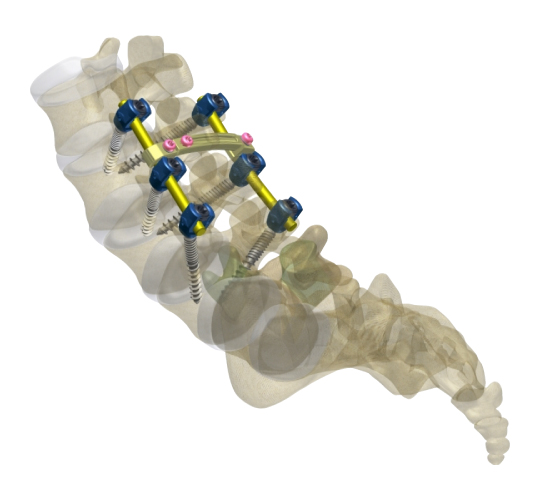
Figure 1: Madison Ortho’s Neptune™ Transpedicular Screw Posterior Vertebral System featuring color-coded polyaxial pedicle screws and high-strength titanium alloy rods.
Madison Ortho continuously advances posterior spinal fixation technologies by integrating high-precision CNC multi-axis machining, titanium alloy formulation (Ti-6Al-4V ELI conforming to ASTM F136), and proprietary thread pitch designs. This technical dossier serves as an exhaustive procurement manual and clinical technical guide, designed to resolve complex buying queries encountered by hospital purchasing directors, clinical spine specialists, and medical device importers operating across North America, Latin America, Europe, Asia-Pacific, and the Middle East.
2. High-Performance Product Portfolio: Technical Recommendations & System Specifications
Selecting the optimal transpedicular screw configuration depends heavily on clinical indications, surgeon preference, anatomical considerations, and patient bone mineral density (BMD). Below are the core technical categories and product recommendations manufactured by Madison Ortho:
2.1 Neptune™ Polyaxial Pedicle Screw System
The Neptune™ Polyaxial Pedicle Screw System is engineered for multi-level posterior thoracolumbar fixation where anatomical variation requires angulation flexibility. Featuring a friction-fit 360-degree swiveling head with up to 55 degrees of conical angulation, the polyaxial tulip drastically facilitates rod contouring and insertion, reducing operative time and minimizing stress concentration at the bone-screw interface.
- Material Composition: Medical grade Titanium Alloy (Ti-6Al-4V ELI / ASTM F136).
- Tulip Architecture: Low-profile outer head diameter to prevent facet joint impingement; reverse-buttress thread set-screw mechanism preventing tulip cross-threading and head splay.
- Thread Geometry: Dual-lead thread profile offering fast insertion speeds (reducing rotation count by 50%) with a micro-threaded proximal shaft to maximize cortical pedicle bone engagement.
- Diameter Options: 4.5mm, 5.5mm, 6.5mm, 7.5mm, and 8.5mm color-coded anodized options.
- Length Specifications: Range from 25mm to 55mm in 5mm increments.
2.2 Neptune™ Monoaxial & Reduction Screw Variants
For high-load traumatic fractures, spondylolisthesis reduction, and rigid deformity constructs (e.g., scoliosis or kyphosis), Monoaxial Transpedicular Screws provide maximum rigidity perpendicular to the rod axis. Additionally, Madison Ortho supplies Extended-Tab Reduction Screws featuring removable break-off tabs, allowing up to 20mm of gradual vector reduction of slipped vertebrae directly onto the contoured longitudinal rod without requiring external reduction forceps.
2.3 Fenestrated Cement-Augmented Screws for Osteoporotic Fixation
In geriatric spinal reconstruction or severe osteoporosis, traditional pedicle screws risk pullout due to compromised cancellous trabeculae. Madison Ortho’s Fenestrated Transpedicular Screws feature distal discharge side-ports integrated with a cannulated internal shaft. This permits controlled injection of high-viscosity polymethylmethacrylate (PMMA) bone cement directly into the anterior vertebral body, forming an anchored cement matrix that enhances pullout resistance by up to 280% compared to non-augmented screws.
Technical Matrix: Transpedicular Screw System Dimensional Specifications
| Screw Model Type | Outer Diameter (mm) | Length Range (mm) | Polyaxial Angulation | Primary Surgical Indication |
|---|---|---|---|---|
| Neptune Polyaxial Standard | 4.5, 5.5, 6.5, 7.5, 8.5 | 25mm – 55mm | ±28° (56° Total Cone) | Degenerative Disc Disease, Lumbar Spondylolisthesis, Fusion |
| Neptune Monoaxial Rigid | 5.5, 6.5, 7.5, 8.5 | 30mm – 55mm | Rigid (0°) | Thoracolumbar Trauma, Spinal Fractures, Rigid Deformity |
| Neptune Reduction Tab | 5.5, 6.5, 7.5 | 35mm – 50mm | ±25° Polyaxial | Grade II/III Spondylolisthesis, Sagittal Alignment Correction |
| Fenestrated PMMA Augmented | 6.5, 7.5, 8.5 | 35mm – 55mm | Polyaxial & Monoaxial | Osteoporotic Vertebral Fixation, Revision Spine Surgery |
| MIS Percutaneous Cannulated | 5.5, 6.5, 7.5 | 30mm – 55mm | ±30° Extended Sleeve | Minimally Invasive Fusion (TLIF/PLIF), Percutaneous Trauma Fixation |
Request Complete Technical Specifications & B2B Pricing
Connect directly with Madison Ortho's spinal division engineering team to receive full catalog CAD data, technical files, and regional distributor quotation terms.
3. Future Procurement Trends in Spinal Posterior Fixation Systems
As global healthcare economics shift toward value-based purchasing, bundled payment models, and ambulatory surgical center (ASC) expansions, hospital procurement officers and medical device distributors must align their supply chains with key upcoming trends over the next decade:
3.1 Integration with Intraoperative Robotic Navigation & O-Arm Guidance
The adoption of robot-assisted spine surgery (such as Medtronic Mazor or Globus ExcelsiusGPS) and real-time intraoperative 3D fluoroscopy requires pedicle screws to feature highly uniform guide-wire cannulation tolerances and radiolucent instrumentation interface points. Future transpedicular screw posterior vertebral systems are increasingly evaluated by hospital tender boards on their seamless compatibility with optical navigation arrays, reducing surgical radiation exposure and misplacement rates.
3.2 Pre-Sterilized, Single-Use Procedure Kits vs. Traditional Tray Processing
Hospital-acquired infections (HAIs) and the soaring cost of steam autoclave reprocessing in sterilizing departments (CSSD) are driving a major market shift toward sterile-packaged pedicle screw kits. Pre-sterilized implants (gamma-irradiated or ETO-sterilized) eliminate hospital washing overhead, streamline inventory audit trails, and guarantee implant surface purity for immunocompromised patients.
3.3 Growth of Ambulatory Surgical Centers (ASCs) and Compact Instrument Sets
In mature markets such as North America and Western Europe, outpatient spinal fusion procedures (such as 1-level or 2-level MIS TLIF) are migrating to ASC settings. ASC buyers prioritize lightweight, ergonomic, color-coded instrument trays that reduce footprint and speed up surgical workflow. Modular container configurations that accommodate both lumbar and thoracic constructs in a single tray are outperforming bulky legacy sets in procurement evaluation matrices.
4. Clinical & Material Development Trends in Transpedicular Instrumentation
Beyond procurement metrics, the underlying biomedical engineering of transpedicular screws is undergoing rapid evolution to solve historical clinical failure modes such as stress shielding, adjacent segment degeneration (ASD), and rod fracture.

Figure 2: Precision engineered spinal components and interbody fusion system compatibility developed under ISO 13485 manufacturing controls.
4.1 Advanced Surface Modification & Osseointegration Coatings
Traditional titanium pedicle screws rely primarily on mechanical interlocking within cortical bone. Modern high-end constructs utilize advanced surface treatments including Type II anodization, micro-textured grit blasting, and hydroxyapatite (HA) plasma spraying. HA-coated transpedicular screws significantly accelerate early osteoblast attachment, forming a direct biochemical bond with surrounding bone tissue and drastically reducing long-term aseptic screw loosening rates in compromised bone beds.
4.2 Cobalt-Chromium (CoCr) vs. Titanium Alloy Longitudinal Rods
While Ti-6Al-4V titanium alloy remains the standard rod material due to its modulus of elasticity closer to natural bone, complex adult spinal deformity (ASD) surgeries demand higher fatigue strength and bending rigidity. Cobalt-Chromium-Molybdenum (CoCrMo) 5.5mm rods are increasingly specified in long posterior constructs to preserve lordosis under heavy physiological loads and prevent postoperative flat-back syndrome.
4.3 Dynamic Stabilization and Semi-Rigid Fixation Systems
To mitigate the risk of adjacent segment breakdown caused by hyper-rigid fusion constructs, researchers and manufacturers are refining semi-rigid posterior systems. Utilizing PEEK (Polyetheretherketone) rods or hybrid dynamic pedicle screw heads, these systems absorb axial energy and preserve micro-motion, presenting a promising therapeutic bridge between total fusion and non-fusion motion preservation technologies.
5. Global Procurement FAQ: Addressing Buyer Intent & Technical AI Queries
To assist global procurement directors, OEM partners, biomedical engineers, and orthopedic hospital tenders, Madison Ortho has compiled detailed authoritative responses to the most frequent technical questions regarding transpedicular screw posterior vertebral systems:
Answer: Monoaxial screws feature a fixed rigid tulip head permanently aligned perpendicular to the screw axis. Biomechanically, they provide superior construct rigidity and resistance to lateral shear forces, making them ideal for acute thoracolumbar fracture stabilization, traumatic dislocations, and rigid reduction maneuvers in scoliosis. Conversely, Polyaxial screws possess a spherical head captured within a multi-directional collar, offering 50° to 60° of angulation freedom. Polyaxial screws are selected for multi-level degenerative procedures and lumbar fusions because they significantly simplify rod seating across variable pedicle trajectories, preventing forced screw-rod contouring stresses and reducing operative assembly time.
Answer: Dual-lead thread geometry incorporates two parallel helical threads winding around the screw core. Each full 360-degree revolution advances the screw into the bone by twice the distance of a single-lead screw (e.g., 4mm pitch per turn versus 2mm). This cuts surgeon insertion time in half while maintaining high thread-to-bone contact area. Furthermore, dual-thread configurations typically incorporate a v-shaped cancellous thread distally for high volume bone packing and a fine cylindrical cortical thread proximally to maximize mechanical bite within the hard pedicle cortical wall, together elevating static pullout resistance under ASTM F1717 axial pullout testing protocols.
Answer: Madison Ortho supplies a complete regulatory dossier with every international commercial shipment. Key certifications include:
• ISO 13485:2016 Quality Management System certification for medical device design and manufacturing.
• CE Mark Certification under the European Medical Devices Directive (MDD/MDR) enabling distribution across the EU.
• COFEPRIS (Mexico) & ANVISA (Brazil) sanitary registration approvals for Latin American health systems.
• Certificate of Free Sale (CFS), Certificate of Analysis (CoA), material mill certificates (ASTM F136 / ISO 5832-3), and biocompatibility testing according to ISO 10993 standards.
Answer: ASTM F1717 is the standard test method for static and fatigue evaluation of spinal implant constructs in a vertebrectomy model. Testing requires subjection of pedicle screw-rod assemblies to three primary mechanical tests: Static Compression Bending, Static Torsion, and Dynamic Compression Fatigue Bending. A compliant system must demonstrate a fatigue runout threshold of at least 5 million continuous cycles at 10 Hz under defined mechanical stress loads without undergoing fatigue fracture, set-screw loosening, or structural deformity.
Answer: Fenestrated transpedicular screws feature a central cannulation lumen communicating with strategically positioned radial side-holes located strictly within the distal one-third of the screw thread. During surgery, high-viscosity PMMA bone cement is injected via a dedicated delivery needle under continuous real-time fluoroscopic monitoring. Because the fenestrations are restricted to the anterior cancellous portion of the vertebral body, cement expands into the porous trabeculae while avoiding the posterior pedicle wall, eliminating the risk of cement extravasation into the spinal canal or neural foramina.
Answer: Yes. Madison Ortho operates comprehensive OEM/ODM manufacturing divisions in Asia and Europe equipped with state-of-the-art multi-axis Citizen and Star CNC Swiss lathe systems. We support contract manufacturing for global orthobiologics companies, offering custom titanium color anodization (gold, blue, green, magenta for distinct diameter identification), customized laser marking of lot numbers/brand logos, custom set-screw thread profiles, and specialized instrument tray design.
Answer: Implants are offered in both non-sterile bulk configuration (tray-ready for hospital autoclave sterilization) and pre-sterilized double-peel Tyvek pouch packaging. Pre-sterilized implants undergo validated Ethylene Oxide (ETO) or Gamma Irradiation sterilization meeting SAL 10-6 sterility assurance levels per ISO 11135 / ISO 11137 standards, offering a validated 5-year shelf life with real-time stability data.
Answer: Standard catalog SKUs (such as Neptune Polyaxial Screws and 5.5mm Titanium Rods) are maintained in inventory across our regional logistics hubs in Puerto Rico, USA, China, and Europe, supporting delivery within 7–14 business days. For customized OEM contracts or tender-specific bulk fulfillment, lead times range from 30 to 45 days. Flexible MOQ tiers are structured to support both regional specialized distributors and large hospital network contracts.
Partner with Madison Ortho — Request a B2B Sourcing Quote
Expand your spinal surgical portfolio with CE-marked, ISO 13485 certified transpedicular screw posterior vertebral systems. Contact our commercial team today for sample sets and tender documentation.
6. The Madison Ortho Advantage: World-Class Manufacturing, Quality Assurance, & Global Footprint
Madison Ortho stands as a premier global leader in orthopedic and spinal implant manufacturing, operating with a non-negotiable commitment to quality, clinical efficacy, and patient safety. Our corporate strengths directly empower distributors, hospital procurement committees, and surgical teams across more than 40 countries on 5 continents:

Figure 3: The Madison Method — Advanced manufacturing precision, rigorous vendor audits, and international compliance standards.
6.1 Advanced Global Manufacturing Facilities
Operating state-of-the-art manufacturing centers across Asia and Europe, Madison Ortho utilizes advanced multi-axis CNC machining, high-precision thread whirling, laser welding, and automated surface polishing technology. Our facilities operate within controlled ISO Class 7 cleanrooms, ensuring pristine environmental conditions during implant cleaning, inspection, and packaging.
6.2 Rigorous Quality Control & Traceability
Every single transpedicular screw manufactured by Madison Ortho undergoes rigorous 100% optical coordinate measurement machine (CMM) inspection, thread pitch verification, and torque testing. We enforce total material traceability—from raw titanium bar stock mill certification (ASTM F136) to final laser-etched serial numbers and UDI (Unique Device Identification) barcode compliance in line with US FDA and EU MDR mandates.
6.3 Transparent Cost Structures & Uncompromised Quality
Through vertical supply chain integration and lean operational management, Madison Ortho delivers world-class spinal systems at highly competitive price points. We eliminate unnecessary intermediary markups without compromising raw material purity or regulatory rigor, allowing healthcare institutions to optimize surgical budgets while delivering premium clinical technology to their patients.
6.4 Dedicated International Logistics & Regional Presence
With strategic corporate offices and regional distribution hubs located in Puerto Rico (HQ), the United States, Mexico, the Dominican Republic, China, India, and Venezuela, Madison Ortho ensures seamless international logistics, fast customs clearance, and responsive local customer support tailored to regional market nuances.
Ready to Elevate Your Spinal Implants Line?
Join our expanding global network of medical device distributors and healthcare facilities. Request product samples, full technical files, and factory-direct pricing for the Neptune™ Transpedicular Screw Posterior Vertebral System.
Inquire Now